Monday, November 6, 2017

Fried Butter?

Mmmmmmm......butter.  In my previous posts, I've discussed carbohydrates and proteins, which leads to the third, very misunderstood, macronutrient that we all know and love, fats. 

Fats are fairly complex molecular chains that provide substantial energy to the human body.  More often than not, it's vilified because of the amount of energy that it provides, the subsequent storage of that energy, and the prevalence of it in our society.  Fats are largely built up of hydrogen and carbon atoms, much like carbohydrates, except that the chains are larger and are usually attached to a glycerol molecule. 
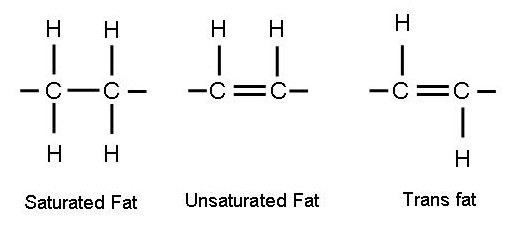
Depending on the type of fat, either unsaturated or saturated (or the really terrible, trans-fat), there are either double bonds in place or not.  Unsaturated fats have at least one double bond on it's molecular structure and are often liquid at room temperature (~70 degrees F).  This would mean that almost all oils such as olive oil or corn oil are some form of unsaturated fats.  Saturated fats however have no double bonds and are solid at room temperature.  Things like natural butter or coconut oil would largely consist of saturated fats.  Finally a third type of fat, one that is widely considered to be the worst kind, are trans-fats.  Trans-fats are essentially man-made fats.  It's basically taking a liquid fat, such as corn oil, and turning it into a solid fat, like butter.  Margarine is an excellent example of a trans-fat. 

Fats are needed for our survival, so it's important that we address them.  Brain & nervous system function, metabolism of some vitamins, thermoregulation (heat/cold tolerance), and even energy are all functions of fats.  Clearly, we need fats.  We, especially as Americans, have an over abundance of dietary fats and thus our bodies are predisposed to store the fats rather than use the fats as energy. 

Part of the reason that we can survive for weeks without food and only days without water has a lot to do with fats.  Our subcutaneous fats, the type beneath the surface of the skin, can provide plenty of energy when in a fasted state.  The more fat that we have to draw from, the longer we can survive in a fasted state (this is not to promote on-going starvation). 

Each gram of fat consists of 9 calories, wheras both protein & carbohydrate are 4 calories per gram.  This in-part is the size of each fat molecule, and the resulting amount of energy stored within.  This contributes to our calorie intake with a greater magnitude than both carbs & proteins and should have more attention devoted to. 

Fats are important for human life.  We need them to survive and thrive and this molecule is often misunderstood.  A low/no-fat diet has it's moment of benefit, but there are also plenty of negative ramifications associated with.  Pay attention to the fats that you consume and you'll be all the better for it. 

Friday, November 3, 2017

WrAp-Up, a molecular conclusion.

Other than the annoying way I decided to do my title, I wanted to go ahead and wrap up the whole molecular structure series that I accidentally started.  It wasn't originally my plan to go ahead with all of that, but by the time I started with writing about the various chemical compositions that are important to exercise, I felt I was onto something. 

My purpose was to educate you partially on the complexity of the human body and how it responds via diet and exercise.  Clearly, we have a lot going on that can dictate our body composition, performance, and even our moods.  The intent that I had was to show you the primary hormones and some additional chemicals that can impact what we do on a regular basis.

Going forward, I am planning on describing the end-game of physical training and healthy eating.  What do I bring to the table as a trainer and coach?  What benefits do you receive from coaching, physically, spiritually, emotionally, and mentally? 

These are some of what I plan on covering in the forthcoming weeks, mainly on Fridays, as I wrap up nutrition and my own story on Mondays and Wednesdays. 

I hope you enjoyed and learned from my molecular discussions.  Learning various hormones and compounds that can impact exercise and ultimately body composition may help you in understanding why things are the way they are.  

Wednesday, November 1, 2017

The path of legends.

Last week, I posted about my initial journey to exercise and what I do now.  I began in middle school and worked my way until I had enlisted in the Marine Corps.  In this post, I want to tell you how the Corps changed my life, in so many ways.

First of all, I'm not a "military brat."  My dad was growing up during the tumultuous time of the Vietnam War and only became of age after it ended.  However, he in-part, and my grandfather who was a WWII veteran did have a profound influence on me.  I chose the Marine Corps for a couple of reasons, first and foremost was that no one in my family had done it before me.  Second, Marines are usually known for their warrior mentality, their physical fitness, and their dedication to each other, all of which I needed in my life (for many reasons, at this point I don't remember them all).  Lastly, the uniform...I mean, have you looked at it?  It's sharp and honestly as a 17 year old, it was for the girls.

When I went into the Marine Corps, the main focus at the
time physically was the Physical Fitness Test or PFT.  As I write this, the Corps has modified the PFT somewhat and has added the Combat Fitness Test to the requirements as well.  The majority of our fitness training consisted of running, seemingly endlessly, pull-ups (especially when we were close to the PFT), and crunches.  If we were fortunate, we'd get some gym time thrown in there as well, but that was rare.

Aside from the platoon level Physical Training (PT), I would spend an additional 1-2 hours daily at the gym.  Looking back, I wish that I could know then what I know now and I'd be much stronger and maybe less dad-bod like than I am.  But what is is what is, and I did what everyone did at that time, consult bodybuilding magazines.  I'd spend endless amounts of time hitting the arms, abs, and chest.  I'd spend some (not much really) time hitting the legs, shoulders, and back.  I usually omitted those areas because I didn't perceive the importance of them and when they hurt, it sucked badly.

One thing that I took on the mantle of, albeit unofficially, was a "personal" trainer to some of my fellow Marines.  The good thing was that I did have some intuition at that point of what was reasonably effective and what wasn't, however it's like a small chip in the ice to what I believe I know now.  I helped my friends improve their PFT, got them dedicated to exercise, and even motivated them to change from the binge drinking and smoking that was so prominent in our lives.  While I would never consider myself as a "personal trainer" at this point in my life, it was essentially what I was doing.

This led me to want to exit the Marine Corps and pursue a college degree in Physical Education, thinking that I could motivate young minds to good fitness and healthy behaviors.  Next week, I'll talk about my undergraduate experience and how that also helped to shape my mindset that I have now.  

Monday, October 30, 2017

Steak with a side of steak

Protein consumption is critical for human health and without it, we cannot function normally.  Typically we associate protein consumption with bodybuilding, muscle growth, and even "crash" diets such as Adkins or South Beach.  Protein is so much more than just a macronutrient we consume to reduce or gain body mass.

Proteins are built up of amino acids, each of which serve various functions throughout the body.  Some amino acids are metabolized (broken down) for use as energy, others as structure as is the case of muscle tissue, and even others as enzymes which transport other molecules from point A to point B in the body.  Clearly, we need protein and a large amount of our bodies are built upon it.

We as humans can receive our protein from a variety of sources, but we can break it down to two different sources, plants and animals.  Plant sources of protein are incomplete, meaning they don't have all the amino acids necessary for construction of complete proteins.  Usually regarding plant sources, you need to consume complimenting foods such as beans & rice.  These two have amino acids that are in the other and each have amino acids that are not found in the other.  
Animal sources, however, are complete.  This is largely because their muscle structure is very similar to our muscle structure.  Therefore, when our bodies digest this protein, we gain all the necessary amino acids for our own health.  There is some argument over the type or quality of an animal source of protein, but universally it is agreed that all amino acids are there.  One thing regarding animal protein that you don't often need to consider with plant protein is the addition of fat, such as in the rib-eye you see to the right.  This changes the digestion of the protein, the satiation, and the flavor of the food.  
Plant proteins sources typically lack fat, whereas animal proteins regardless of it's source contain some.  I'll be discussing fats next week for you.  But know,  that if a low fat diet is something that you desire or are required, then you may want to consider a plant protein over an animal.  
Finally, protein consumption can aid in the change of body composition.  If you are overweight a high consumption of protein can actually make you feel full longer, thus resulting in a decrease in the quantity of calories consumed.  Protein takes longer to diegest than carbohydrates or fats, which allow for this.  There is also more energy required, called the thermogenic effect of food, to break down protein sources to the amino acids needed to enter the blood stream. 

Proteins are super important for your diet, regardless of whether weight loss or mass gains are what you're looking for.  Take the time to focus on what proteins you like and these should serve as the hub of your meals, with your carbs and fats to go around them.  


Friday, October 27, 2017

C18H24O2

Estradiol (Estrogen) is a hugely important hormone which is found more abundantly in women.  It is important to note that this hormone is also found in men, just in far less quantity; which is a similar concept regarding testosterone in women.

Estradiol is important in a variety of functions throughout the human body, not only regarding the reproductive system, for which it's much more widely known for. 

Regarding exercise and estradiol, it's not nearly as important or effective in promoting performance and body composition (positive changes).  Some definite positive things that estradiol promotes is a healthier cardiovascular and nervous system.  The hormone has protective effects which would be why cardiovascular disease (and neurological diseases) are less evident in younger women rather than older women, when estradiol levels fall. 

Body compositionally, estradiol does not have many of the same positive effects that testosterone has.  While testosterone promotes an increase in action potentials (nervous impulses), estradiol doesn't have that same effect.  Testosterone can promote a larger muscle structure, which is why men are typically larger than women.  Estradiol can promote an increase in body fat, which is why women typically have greater amounts of body fat than men.  This increase isn't necessarily a bad thing, however, it does have an important factors when it comes to children, which men cannot support via biology. 

Performance-wise, estradiol doesn't have a significant impact.  Body composition-wise, it can.  If you regularly assess your body composition, you may find that there are fluctuations each month (I wonder why?).  In any case, estradiol is necessary for good health, for both men and women.  

Wednesday, October 25, 2017

A step inside

Exercise wasn't always my thing.  I was honestly a sort of "fat" kid during my middle school years and I think that those scars are still there decades later.  I look into a mirror and often do not like what I see, even if others disagree with me on that one. 

I wasn't always this way.  When I was much younger, I did Tae Kwon Do and was honestly somewhat fit at the time I was doing it.  It was a move from New York to Pennsylvania that honestly changed me.  As with most kids upon a fairly large move, it was hard to deal with emotionally.  I turned to isolation and eating and it spiraled out of control.  I look back at it now and I see that I would've been considered depressed and likely "medicated" if it were now. 

What originally started the whole thing was the Marine Corps.  I set my sights on that early on and it translated into many of my decisions that I made from that point forward.  I started out in the band (yes...band geek) and this is where I first really saw the weight begin to fall off.  Largely because I was marching around a field for several hours a day 5-7 days per week with a 20(ish)lbs instrument held up near my face.  I also began playing ice hockey during the winter, which allowed for more activity to take place.  The band, at least the motivation as I remember it, was to develop the skills for marching, as Marines do. 

Either my sophomore year or junior year of high school, I began to lift weights and run.  Again, with the Marine Corps as my motivation.  I was pursuing an officer route, which in the end I didn't get, but it drove me hard.  This motivation was more evident my senior year of high school, which I had enlisted a week or so prior.  I spent more time running and lifting, especially working on my pull ups, than before.  My skill set wasn't too high at that point, but I made up for it in enthusiasm and motivation. 

I'll continue my exercise journey next week with the time I spent in the Corps and how it pointed me more on the path that I'm on today. 

Monday, October 23, 2017

I'll take a potato.....

Carbohydrates are often vilified.  Look at Adkins or the South Beach diet and you'll basically think that carbs are the worst thing that you could ever consume...ever.  In a way, they can be, and in many others they are far from it.

Previously, I've talked about calories and how they're important for you to know, especially those you should be consuming.  Carbs provide you with 4 calories per 1 gram of carbohydrate.  So it's generally easy, if you're pretty math savvy, to determine your carbohydrate calories.  Fiber, a type of carbohydrate, almost "subtracts" their grams from your total carbohydrate, which would equal less calories.

Carbs are used for energy, and thus you should be
doing some level of movement to actually use them.  They are consumed, broken down into it's simplest components, and sent into your cells for use as a quicker source of energy.  So, carbs aren't useless.  If you're regularly exercising or in a vigorous occupation, then you'll need carbs to fuel you.  If you're not doing anything like that, then carbs aren't something that you'd likely concern yourself with, except that they taste good.

Villainous carbs are really not.  The molecule receives negative feedback because when you consume a carb and a fat together, say...French Fries...then your body will prefer the carbs for use as energy and likely (unless you're hypocaloric) store the fat (from the oil) as fat.  Most of our American diet consists of many foods that are carb rich and fat rich, and so it's likely that we'll gain fat mass over anything else. 

Something else to consider....all carbs are sugars.  Like, all of them.  We can break it down molecule by molecule, but even starches, such as potatoes, are sugars when our stomachs and small intestines get a hold of them.  Glucose, a type of sugar, is the end result of this breakdown and it's the "blood sugar" that we often refer to.  All carbs, "good" or "bad" contribute to this.  Blood sugar isn't inherently bad, it's just in high doses, it's not good.  Just as much as too low is bad.

Carbs contribute energy to your body and with this energy your vital organs can function.  Vital organs such as your brain (duh!), your heart, your intestines, etc.  Without carbs, you fail to function.  In the end, even on a low carb diet, you crave carbs, or your body converts various tissues and cells and molecules to glucose.  So, before you hate on carbs, know where and when they fit into your life.